


Blog
Automotive Industrial Automation: The Complete Guide for Manufacturers

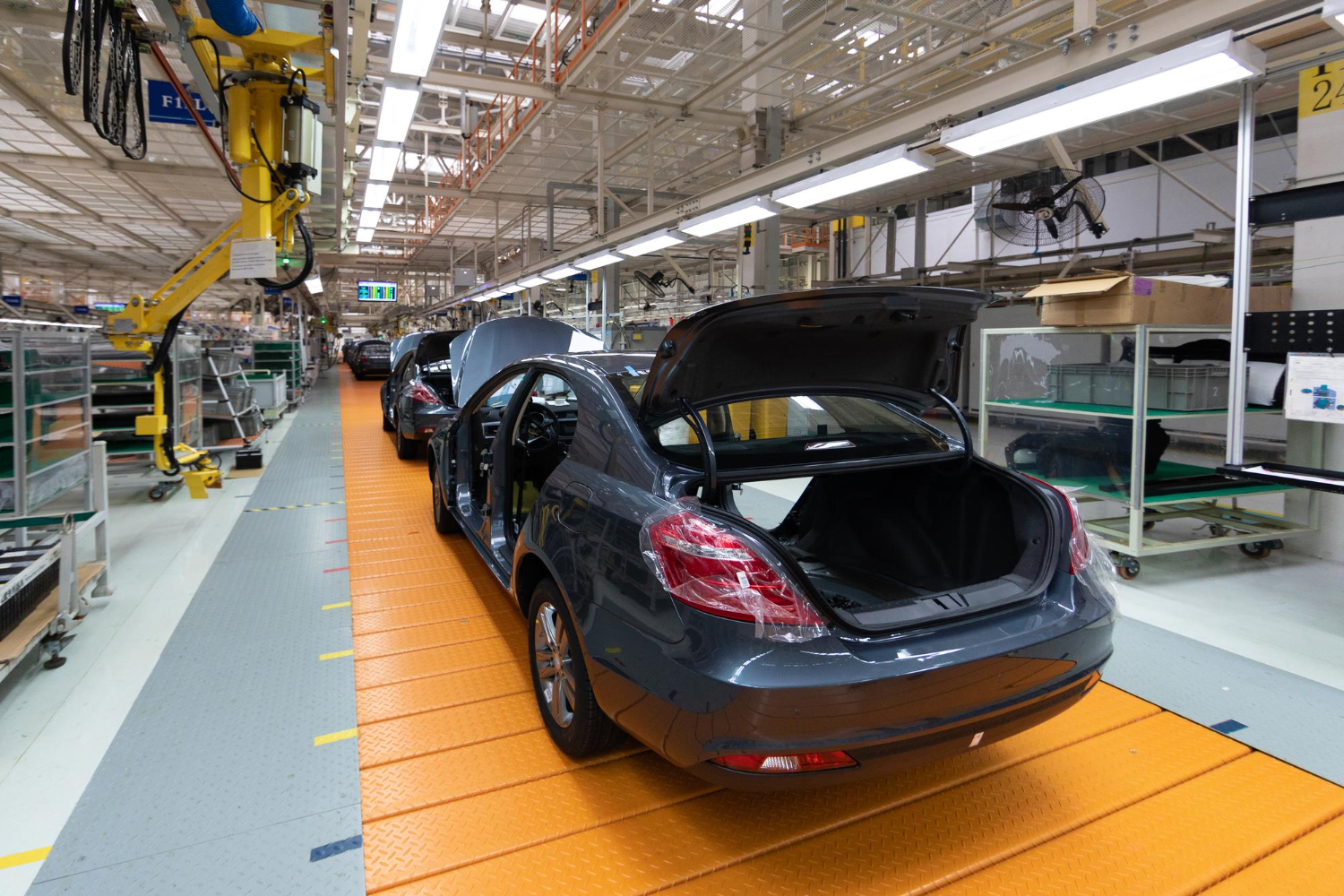
Automotive industrial automation is the use of robots, programmable controllers, machine vision, automated material handling, and connected data systems to build vehicles and vehicle components with greater speed, precision, and consistency than manual processes can deliver. It runs through every stage of production, from stamping and body welding to paint, powertrain, final assembly, and end-of-line testing. Manufacturers invest in it to hit tighter tolerances, protect their people from the most punishing tasks, keep up with model variety and EV demands, and capture the traceable data that OEMs now expect on every part.
That’s the short answer. This guide gives you the long one. Whether you run a Tier 1 supplier plant, manage a vehicle assembly line, or are building the case for your first robotic cell, you’ll find a clear picture of what automotive industrial automation includes, where it fits on your floor, what it costs, and how to roll it out without the expensive surprises that derail so many projects. Along the way, you’ll find links to deeper guides on each major topic, so you can dig into whatever matters most to your plant.
What Automotive Industrial Automation Actually Includes
People use the word “automation” to describe everything from a single robotic arm to a fully connected smart factory, which makes the term slippery. It helps to break it into the layers that work together on a modern line.
Robotics. Industrial robots handle welding, material transfer, painting, dispensing, fastening, and increasingly, delicate assembly work. They give you repeatable motion at production speed. Our guide to automotive robotics and robot integration covers the types, applications, and integration work in depth.
Controls. Programmable logic controllers (PLCs) and human-machine interfaces (HMIs) act as the brains and the dashboard of every automated station. They sequence the equipment, respond to sensor signals, and show operators what’s happening in real time.
Machine vision and sensing. Cameras, laser scanners, and sensors let a station confirm that parts are present, correctly positioned, and built to spec. Vision also guides robots when parts arrive with small variations. Read more in our breakdown of automotive machine vision and inspection systems.
Material handling. Conveyors, automated guided vehicles, autonomous mobile robots, and robotic part transfer deliver components where they need to be, when they need to be there. Our guide to automotive material handling automation explains how to choose between them.
Safety systems. Light curtains, interlocked guarding, safety-rated controllers, and area scanners protect people who work around automated equipment. Safety design belongs in the layout from the first sketch, not as a late addition.
Data and connectivity. Manufacturing execution systems (MES), industrial IoT sensors, and plant dashboards turn machine activity into information. They track output, downtime, quality trends, and part-level traceability.
No single layer delivers results by itself. The value comes from how well these pieces get designed, programmed, and tuned to work as one system. That’s why so many manufacturers bring in an experienced systems integrator rather than assembling the pieces on their own.
If you want a gentler starting point on the fundamentals, our post on what automotive manufacturing automation is walks through the definition, the benefits, and the basic mechanics.
Why Automotive Manufacturers Are Investing in Automation Now
Automotive plants have used robots since the 1960s, so automation itself isn’t new. What’s changed is the pressure on manufacturers and the capability of the technology available to answer it.
Skilled Labor Is Hard to Find and Harder to Keep
Experienced welders, machinists, and controls technicians are retiring faster than new ones are entering the trades. Automation helps by taking over repetitive, physically demanding tasks, which frees your skilled people for work that needs their judgment: programming, troubleshooting, process improvement, and quality problem-solving. Plants that automate often find that roles built around those higher-skill tasks are easier to fill and keep.
Precision Requirements Keep Tightening
Modern vehicles, and EV platforms in particular, demand tolerances that manual processes struggle to hit consistently. Battery assemblies, structural welds, and high-voltage connections leave little room for variation. An automated station holds the same position, force, and timing on the first unit of the day and the thousandth.
Model Variety Is Now the Norm
A line once ran one model at high volume. Today, plants run multiple trims, body styles, and even powertrains down the same line. Flexible automation, built around programmable equipment and quick-changeover tooling, handles that variety far more gracefully than rigid, single-purpose setups.
Traceability Has Become a Requirement
OEMs and regulators increasingly expect proof that every weld, fastener, and test met spec, tied to a specific vehicle or part. Automated stations record that data as they work. Manual processes can’t match that level of documentation reliably.
Safety Expectations Keep Rising
Heavy lifting, repetitive strain, welding fumes, and high-voltage components all create risk for the people who work with them. Automation moves those tasks away from people, which lowers injury rates and the costs that come with them.
The Technology Keeps Getting More Capable and Accessible
Robots, vision systems, and controllers have become more capable and easier to program, and many applications now reach payback faster than they did a decade ago. That changes the math for plants that once considered automation out of reach.
Where Automation Fits on the Automotive Production Line
Every major stage of vehicle production uses automation, though the mix of automated and manual work differs from stage to stage. Here’s how it plays out across the plant. For a closer look at how these pieces interact at the station level, see our guide on how automation for automotive manufacturing works.
Stamping and Forming
Automated presses shape sheet metal into body panels, while robots and transfer systems load blanks and unload finished parts. These are repetitive, high-force tasks that put heavy strain on people over a full shift, so automation fits naturally here.
Body-in-White Welding
The structural shell of the vehicle comes together through hundreds or thousands of welds. Robots perform spot welding, MIG welding, and increasingly laser welding with consistent placement and strength, while weld monitoring records the parameters of each joint. It’s one of the most heavily automated stages in any plant, and our deep dive on automotive robotic welding systems explains each process and how to choose between them.
Paint Shop
Spray robots apply primer, base coat, and clear coat in tightly controlled conditions. Consistent film thickness and coverage make a visible difference in finish quality, and automation also removes people from fume exposure and repetitive motion.
Powertrain and E-Drive Assembly
Engines, transmissions, and electric drive units go together through precision torqueing, press-fitting, and testing, with each operation logged against a serial number. For EV production, this stage also includes motor, power electronics, and gearbox assembly.
Final Assembly
Final assembly blends automated and manual work. Robots and automated stations handle windshield installation, fluid filling, and fastening, while tasks that need human dexterity, like some wiring and interior trim work, often stay manual or semi-automated. Smart sequencing keeps both kinds of stations in step. Our guide to automotive assembly automation covers line design and best practices in detail.
End-of-Line Testing
Before a vehicle ships, it goes through functional tests, dimensional checks, leak tests, and a final vision inspection pass. This is the last checkpoint where a manufacturer controls whether a defect ships, and our guide to automotive end-of-line testing explains what a complete program covers.
Logistics Throughout
Behind every stage, conveyors, automated guided vehicles, and robotic transfer systems keep parts flowing. These systems often get less attention than robots, yet they strongly influence how well everything else performs.
The Core Technologies, Explained
A quick look at the main technologies helps you ask better questions when you evaluate a project.
Industrial Robots
Six-axis articulated robots do most of the work on automotive lines, handling welding, transfer, dispensing, painting, and fastening. SCARA robots suit fast, lightweight pick-and-place tasks. Collaborative robots fit lower-volume jobs and tight spaces where people and robots share a workspace. Platforms from manufacturers like FANUC, ABB, KUKA, and Yaskawa dominate the market, and plants often standardize on one or two so maintenance teams and spare parts stay manageable.
PLCs and HMIs
PLCs read sensor inputs, run through programmed logic, and send commands to robots, conveyors, and tools. Good PLC and HMI programming handles the exceptions as well as the normal sequence: the double-fed part, the intermittent sensor, the pause mid-cycle. That discipline often decides whether a station runs smoothly or needs constant attention.
Machine Vision
Vision systems check for missing components, misaligned parts, surface flaws, and dimensional errors at line speed, and they guide robots to correct for small part variations. Lighting design and training on real production parts matter as much as camera resolution, and they separate reliable systems from ones that flood operators with false alarms.
Sensors and Safety Devices
Proximity sensors, photo-eyes, encoders, and pressure sensors form the nervous system of every station. Safety-rated devices, including light curtains, scanners, and interlocks, protect people who work nearby and keep the line from stopping unnecessarily.
Material Handling Systems
Conveyors suit fixed, high-volume routes. Automated guided vehicles follow set paths. Autonomous mobile robots navigate on their own and adapt when layouts change. Robotic transfer and gantry systems handle heavy or awkward parts at the station level.
MES, IoT, and Data Platforms
Manufacturing execution systems and connected sensors collect data from across the line. They track overall equipment effectiveness (OEE), flag the causes of downtime, and link quality results to individual vehicles. Plants use this information to find bottlenecks, schedule maintenance, and prove compliance.
Choosing How to Buy: Custom, Turnkey, or Off-the-Shelf
Once you know what to automate, you face a delivery decision. Three models cover most projects, and each fits a different situation.
Off-the-shelf equipment works for generic, well-understood tasks, such as basic transport or standard palletizing. It costs less upfront and arrives quickly. It struggles when your part geometry, layout, or line requirements don’t match the standard design. Our post on why off-the-shelf falls short on the line explains where that gap shows up.
Turnkey systems start from a proven, pre-engineered design for a common application and adapt it to your parts and layout. You get faster delivery, lower engineering risk, and more predictable pricing. Our guide to turnkey automotive automation systems explains what’s usually included and what typically isn’t.
Custom-engineered systems start from your specific process, part, and floor space. They fit unusual parts, tight synchronization needs, multi-model production, and emerging processes that don’t have a mature standard design yet.
Most plants end up using a blend: turnkey or standard equipment for common tasks, and custom engineering where the process truly demands it. An honest integrator will tell you which category each station belongs in, instead of steering you toward whichever option earns them the most.
Designing the Line, Not Just the Stations
Plants often start by automating one station at a time. That works well as a starting point, yet it carries a ceiling. A line behaves like a chain, and it only moves as fast as its slowest link.
Strong line-level design looks at the whole system. It balances work across stations so none becomes a constant bottleneck. places automated and manual stations deliberately, sizes buffers based on real reliability data, and builds in the flexibility to handle model variety through reprogrammable equipment and quick-changeover fixturing. It also coordinates the handoffs between stations, since a lot of lost time hides in the gaps rather than inside the machines.
Our guide to automotive production line automation covers how to improve throughput, flexibility, and uptime together, and why pushing on one often affects the others.
Automation for EV Production
Electric vehicle production adds new demands that traditional lines weren’t built for. Battery packs are heavy yet sensitive. High-voltage components create serious electrical risk. Contamination control matters more, and traceability expectations run higher. Many of these processes don’t yet have mature, standard automation solutions, which makes thoughtful engineering especially valuable.
Automation supports EV work through robotic cell and module handling, precision joining of electrical connections, controlled adhesive dispensing, automated fastening and sealing, e-drive assembly, and high-voltage testing with strong safety features. Because battery and e-drive designs keep evolving, flexibility matters more here than almost anywhere else. Our guide to EV battery manufacturing automation breaks down each stage and what to plan for.
What Automotive Industrial Automation Costs
Costs vary with scope, volume, and complexity, so treat any figure as a rough guide. These ranges give a sense of scale for common projects.
| Project type | Typical range | What drives the cost |
| Vision inspection station | 30,000–100,000 | Camera count, lighting, part complexity |
| Single robotic welding cell | 150,000–400,000 | Process type, fixturing, safety guarding |
| Material handling segment | Varies widely | Distance, system type, integration needs |
| Full body-in-white framing line | Millions | Station count, process mix, controls |
Equipment usually makes up only part of the total. Engineering, fixturing, controls programming, safety guarding, installation, and commissioning often account for a large share, and underestimating them causes many budget overruns.
On the savings side, plants commonly see gains in several areas:
- Lower labor cost per unit on automated stations, through reduced overtime and reallocated effort
- Reduced scrap and rework on processes prone to variation, like welding and torqueing
- Fewer safety incidents on heavy, repetitive, or hazardous tasks
- Higher uptime when sensor data supports predictive maintenance
- Stronger quality documentation that supports OEM audits and sourcing decisions
Payback depends heavily on volume, shift structure, and local labor costs. High-volume lines often reach payback in a couple of years, while lower-volume or highly customized production can take longer. That’s exactly why prioritization matters so much in the planning stage.
How to Build Your Automation Roadmap
A phased approach beats a sweeping overhaul in almost every case. Here’s a sequence that works well.
- Start with real data. Gather cycle times, downtime causes, scrap rates, safety incident reports, and overtime spend across multiple shifts. Guesses about where problems live are often wrong.
- Find your constraints. Improving a station that isn’t the bottleneck doesn’t change total output. Identify what actually limits the line.
- Separate must-automate from nice-to-automate. High-risk, high-repetition, and high-precision tasks usually justify automation first, often on safety grounds alone.
- Match the delivery model to the task. Decide station by station whether standard, turnkey, or custom engineering fits best.
- Budget for the whole project. Include integration, fixturing, safety, training, and commissioning alongside the equipment itself.
- Plan for flexibility. Ask what models, volumes, and processes will appear in the next three to five years, and build that adaptability into each project.
- Train your people early. Operators and maintenance technicians need to understand the new equipment before go-live, not after.
- Keep the data flowing. Connect new stations to dashboards your team reviews regularly, so improvements stick and new problems surface early.
Common Mistakes to Avoid
A handful of patterns show up again and again in projects that underdeliver.
Automating a flawed process. If a station has workarounds or known quality issues, automating it as-is locks in the problem at higher speed. Fix the process first.
Choosing equipment before defining requirements. Buying robots and then figuring out the application leads to awkward compromises. Define the task, the parts, and the performance targets first.
Treating material handling and data as afterthoughts. Stations that run beautifully but sit waiting on parts, or that generate no usable data, never reach their potential.
Skipping simulation and design review. Catching a reach problem or a collision risk on a screen costs a fraction of fixing it on the floor.
Underinvesting in training and maintenance planning. The best system underperforms when the team doesn’t know how to run and maintain it.
Ignoring the long game. Designing purely for today’s volume and model often means paying much more later to add flexibility.
How to Choose an Automation Partner
Few plants build complex automation entirely in-house, so partner selection shapes your results as much as the technology does. Our guide on how to choose the right automotive automation company goes deeper, and these points give you a head start.
Look for relevant automotive experience. A company with strong packaging or warehouse automation credentials may not know the tolerances, duty cycles, and safety requirements of body-in-white work or battery assembly.
Check platform expertise. If your plant standardizes on a specific robot or controller brand, an integrator with deep experience on that platform commissions faster and supports you better afterward.
Ask how much work happens in-house. Teams that handle mechanical design, controls programming, and robot programming themselves coordinate more tightly than those who subcontract most of the engineering.
Request detailed proposals and real references. A clear scope that spells out what’s included and excluded prevents disputes later, and references from comparable projects show how a partner performs when things get complicated.
Ask about life after go-live. Spare parts, remote diagnostics, and ongoing support matter over the 10 to 15 years a system typically stays in service.
For a full selection framework and the questions worth asking before you sign, read our guide to the automotive automation systems integrator role.
Automotive Automation Trends to Watch
Several developments are shaping how plants plan their next investments.
EV and battery production is reshaping requirements. New processes, tighter safety needs, and fast-changing designs push demand for flexible, well-instrumented automation.
Collaborative robots are filling gaps. They handle lower-volume tasks, tight spaces, and operations where a person and a robot work side by side, and they widen the range of jobs worth automating.
AI-assisted vision is improving inspection. Systems that learn to separate real defects from normal variation reduce false rejects and catch subtle flaws that rule-based logic misses.
Predictive maintenance is going mainstream. Sensor data on vibration, current, and temperature lets teams service equipment before it fails, instead of reacting to breakdowns or following rigid calendars.
Connected, data-driven plants are becoming the baseline. Real-time visibility into OEE, downtime causes, and part-level traceability moves from a nice feature to an expectation.
Autonomous mobile robots and smarter fleet software are making flexible material flow practical in plants where layouts and routes change.
Software-driven changeovers are replacing hardware-driven ones. Lines that load new programs and parameters automatically adapt to model variety faster than lines that need manual retooling.
The common thread is adaptability. The automation that serves a plant best over the next decade will likely be the automation designed to change as products, volumes, and processes evolve.
Where to Go From Here
This guide covers the landscape, and each topic above has its own deeper resource. If you want a broader solutions-level view, our complete overview of automotive automation solutions pairs well with this guide. If you’re weighing industrial automation more broadly across your operation, our buyer’s guide to industrial automation solutions for automotive manufacturers covers that decision. And when you’re ready to look at your own line, our automotive manufacturing automation services page outlines how we approach projects.
Building Automation That Fits Your Plant
Automotive industrial automation works best when you treat it as a long-term capability instead of a one-time purchase. The plants that get the most from it start with real data, prioritize the stations where automation pays off fastest, design for the whole line, and choose partners who take ownership of the outcome.
Fenbotics supports that approach from the first conversation. Based in Lancaster, South Carolina, our team handles robotic integration, PLC and HMI programming, vision systems, material handling, and safety design in-house, so your project doesn’t get lost in handoffs between subcontractors. We start by looking at your parts, your line data, and your production goals, then tell you plainly where a proven turnkey design fits and where your process calls for something built from scratch. If you’re mapping out your next automation project, or trying to decide where to begin, we’re glad to talk through your line with you.