


Blog
Automotive Robotics & Robot Integration: Applications Across the Production Line

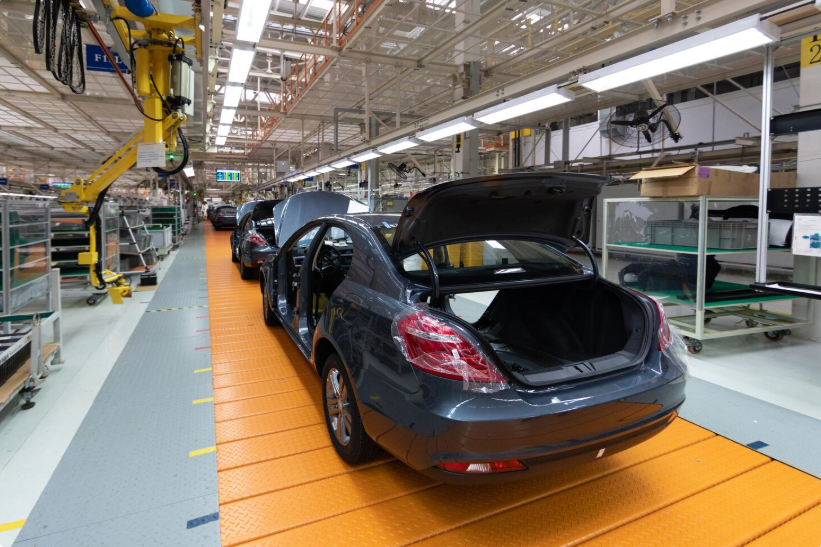
Automotive robotics covers the industrial robots that weld, handle, paint, fasten, and inspect vehicle parts on the production line, while automotive robot integration is the engineering work that gets those robots actually running your process — programming their paths, connecting them to sensors and controllers, and tuning them to your specific parts and cycle time. The robot is the tool. Integration is what turns that tool into a working station that performs reliably, shift after shift, on your actual product.
That distinction matters because most manufacturers evaluating robotics spend their time comparing robot brands and payload specs, when the real difference in outcomes usually comes down to how well the robot gets integrated into the rest of the line. Here’s where robots actually show up across an automotive plant, what makes integration work, and what to think about before choosing a platform.
The Robot Types Behind Automotive Automation
Not all industrial robots are built the same way, and the differences matter for how they get applied on a line.
Six-axis articulated robots are the most common type in automotive plants — jointed arms that move with the same range of motion as a human shoulder, elbow, and wrist. Their flexibility makes them suitable for welding, material handling, dispensing, and painting, which is why they dominate body-in-white and paint shop applications.
SCARA robots move in a more limited, faster pattern, ideal for high-speed pick-and-place tasks where the motion doesn’t need full six-axis flexibility. These show up more often in electronics and smaller component assembly than in heavy body work, but they’re increasingly common in EV batteries and electronics sub-assembly.
Collaborative robots (cobots) are designed to work safely alongside people without the same heavy guarding a full industrial robot requires, making them a fit for lower-volume tasks, tight spaces, or operations where a human still needs to be directly involved in the process.
Delta robots excel at very fast, light pick-and-place work, most often seen in packaging and sorting rather than core vehicle assembly, though they do show up in some component-level automotive applications.
Most automotive lines use a mix of these, matched to each station’s specific job rather than standardizing on one robot type for everything.
Where Robots Actually Show Up on the Line
Welding
Robotic welding remains the single most common automotive robotics application, handling spot welding, MIG welding, and increasingly laser welding on body-in-white assembly. A single body shell can require hundreds of individual welds, and robots deliver a level of placement and strength consistency manual welding can’t match at that volume.
Material Handling
Robots load and unload stamping presses, move parts between stations, and handle heavy or awkward components that would otherwise strain workers over a full shift. This is often one of the easiest automation applications to justify on safety grounds alone, since repetitive heavy lifting is a leading cause of workplace injury in manufacturing.
Painting and Coating
Paint robots apply primer, base coat, and clear coat with a consistency that’s difficult for a human operator to replicate across every panel, every vehicle. Because paint booths involve fumes and require precise environmental control, this is also one of the applications where manufacturers see the clearest safety argument for automation.
Fastening and Assembly
Robots increasingly handle precision fastening tasks — installing bolts, screws, and clips at specific torque values, with the result logged automatically for traceability. This matters more than it used to, since OEMs and regulators expect documented proof that critical fasteners met spec on every vehicle.
Sealing and Dispensing
Applying adhesives, sealants, and foam requires precise, consistent bead placement, and robots handle this task with far less material waste and far more repeatability than manual application.
Vision-Guided Applications
Robots paired with machine vision can adjust their approach in real time based on part position, picking parts from a bin without precise fixturing or correcting their path when a part arrives slightly out of position. This pairing has become common enough that vision-guided robotics is almost its own category within automotive automation.
Emerging Applications: EV and Battery Assembly
Electric vehicle production has opened up newer robotic applications that didn’t exist at scale a decade ago. Battery pack assembly requires precise, repeatable handling of heavy modules, often in a controlled environment where contamination control matters. High-voltage connector installation demands consistent force and positioning where a mistake carries real safety risk. E-drive unit assembly involves tight tolerances similar to traditional powertrain work, but with different component geometries and testing requirements.
These applications are still maturing industry-wide, which means fewer proven, off-the-shelf robotic solutions exist for them compared to established processes like body welding. That gap is exactly where thoughtful automotive robot integration work adds the most value right now.
What Robot Integration Actually Involves
Buying a robot is the easy part. Getting it to reliably perform your specific task, on your specific parts, at your required cycle time, is where integration work happens.
Programming the Robot’s Path and Logic
A robot doesn’t know how to weld your specific part until someone teaches it — either through manual programming, offline simulation software, or a combination of both. This includes not just the main motion path, but the logic for handling variations: what happens if a part is slightly out of position, what happens if a sensor doesn’t confirm placement, what the robot does if the process needs to pause mid-cycle.
Integrating Sensors and Vision
A robot working in isolation, blind to its surroundings, is far less capable than one connected to sensors and vision systems that confirm part presence, position, and quality throughout the cycle. Wiring this feedback loop together — and making sure the robot actually responds correctly to what the sensors report — is core integration work, not an afterthought.
Designing End-of-Arm Tooling
The gripper, weld gun, or dispensing head at the end of a robot’s arm is almost always custom-designed for the specific part it’s handling. Off-the-shelf tooling rarely fits a unique automotive component well, which makes end-of-arm tooling design one of the more specialized skills a good integrator brings to a project.
Coordinating Multiple Robots and Stations
Many automotive stations involve more than one robot working in close proximity, sometimes even sharing a workspace on overlapping tasks. Coordinating their timing so they don’t collide, and sequencing their work so the station hits its overall cycle time, takes careful programming and often specialized safety zoning.
Designing for Multi-Model Robotic Assembly
Since most modern lines run more than one product variant, robot programs increasingly need to switch between different weld patterns, different grip points, or different torque values automatically, based on which variant is currently at the station. Multi-model robotic assembly relies on clean program libraries and reliable part identification working together, so the robot always knows which version of its job to run without a manual changeover.
Choosing a Robot Platform: What Actually Matters
Manufacturers often ask which robot brand is “best,” but the more useful question is which platform fits your plant’s existing standards and your integrator’s expertise.
Standardization matters more than brand prestige. If your plant already runs several FANUC robots, adding another FANUC cell usually means faster commissioning, easier parts sourcing, and a maintenance team that already knows the platform. A working relationship with a FANUC system integrator, specifically, often pays off through familiarity with that platform’s programming environment and support ecosystem, rather than starting from scratch with an unfamiliar brand.
Payload and reach need to match the actual part, not a generic spec. A robot rated for more payload than you need adds cost without benefit; one rated too close to your actual part weight leaves no margin for tooling weight or unexpected load variation.
Programming environment affects long-term flexibility. Some platforms offer more mature offline simulation and easier reprogramming for multi-model production than others. If your plant expects frequent product changes, this is worth weighing as heavily as the robot’s raw mechanical specs.
Local support and parts availability shouldn’t be an afterthought. A robot platform with limited service support in your region can turn a minor failure into an extended downtime event simply because the right technician or part isn’t nearby.
Why the Integrator Relationship Matters as Much as the Robot
A skilled automotive automation systems integrator brings more to a robotics project than programming labor. They bring pattern recognition from dozens of past projects — knowing which approach to a similar welding application worked well, which tooling design held up over years of production, which programming shortcuts create problems six months down the line that aren’t obvious at commissioning.
This is also where the choice of platform and the choice of integrator connect directly. An integrator with deep experience on your chosen robot platform can typically deliver a more reliable, better-tuned system than one working outside their core expertise, even if both are competent generalists on paper.
Common Mistakes When Adding Robotics to a Line
A few recurring issues show up across robotics projects, regardless of which application or platform is involved.
Underestimating end-of-arm tooling complexity. Teams sometimes treat the gripper or weld gun as a minor detail compared to the robot itself, when in practice it’s often the piece most specific to your part and the most likely source of early reliability issues. Budgeting real design time and iteration for tooling pays off later.
Programming for the ideal part instead of the real one. A robot programmed and tested against a perfect sample part can struggle the moment it meets a part with normal production variation — slightly different surface finish, minor dimensional drift, a different batch of raw material. Testing against a realistic range of actual production parts during commissioning catches this before it becomes a recurring line issue.
Skipping simulation before committing to a cell layout. Offline simulation software lets an integrator test a robot’s reach, cycle time, and collision risk before a single piece of steel gets cut for the actual cell. Skipping this step to save time upfront often costs far more time later, when a physical layout issue surfaces during installation.
Assuming more robots automatically means more capacity. Adding a second robot to a station only helps if it addresses the actual bottleneck. A robot added to a station that wasn’t the constraint just adds cost and complexity without moving overall line output.
Overlooking maintenance access during cell design. A robot cell designed purely around cycle time and footprint, without leaving room for a technician to safely access the controller cabinet or replace a worn tool, turns routine maintenance into a much longer, more disruptive task than it needs to be.
Robotics and the Rest of the Automation Stack
Robots rarely operate as standalone islands on a modern line. They work in coordination with vision systems that guide and verify their actions, with programmable logic controllers that sequence their timing against the rest of the station, and increasingly with plant-wide data systems that log every cycle for traceability and quality review.
This connectivity is part of why robot integration has become its own specialized discipline rather than something a plant’s general maintenance team handles alongside everything else. A robot’s mechanical performance is only half the equation; how well it communicates with the sensors, controllers, and software around it determines whether a station runs smoothly or requires constant troubleshooting. Manufacturers evaluating a new robotics project benefit from thinking about that full connected picture from the start, rather than treating the robot purchase as a decision separate from the rest of the automation stack.
Getting the Most From Robotics on Your Line
Automotive robotics only delivers real value when the robot is matched to the right application and integrated with the same care as every other part of the line. A capable robot with poor integration underperforms. A modest robot with excellent integration often outperforms expectations. The technology matters, but the engineering behind it usually matters more.
Fenbotics brings that integration expertise to every robotics project we take on. Based in Lancaster, South Carolina, our team handles robot programming, end-of-arm tooling design, and sensor and vision integration in-house, matched to the platforms our clients already run and the specific parts they need handled. If you’re weighing which robotic applications make sense for your line, or which platform fits your plant best, we’re glad to walk through your process and help you figure out where robotics can deliver the clearest return.