


Blog
Automotive Production Line Automation: Boosting Throughput, Flexibility & Uptime

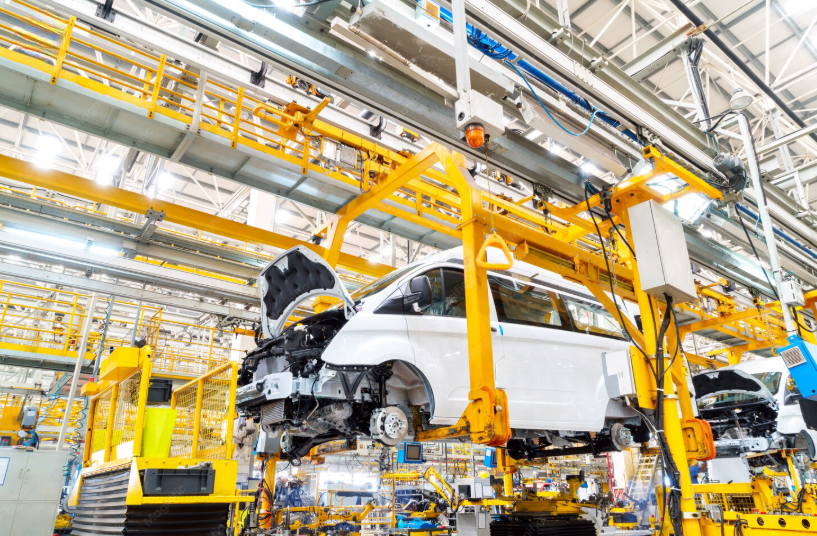
Automotive production line automation boosts throughput, flexibility, and uptime by attacking the three things that quietly drain a plant’s output: slow or inconsistent cycle times, rigid equipment that can’t handle model variety, and unplanned stoppages that nobody saw coming. Throughput improves when you shave seconds off the slowest stations and eliminate micro-stops. Flexibility improves when programmable equipment and smart part identification replace hard-wired, single-purpose setups. Uptime improves when sensor data and predictive maintenance flag problems before they shut the line down. Do all three well, and the same floor space, the same shifts, and the same headcount produce noticeably more good vehicles.
That’s the short version. The longer version is where the real value sits, because each of these outcomes has its own set of levers, and plants that chase only one usually end up trading away the others. Here’s how to think about all three together.
Why Line-Level Automation Is Different From Station-Level Automation
Most plants start their automation journey one station at a time. A robotic weld cell here, a vision inspection station there. That’s a perfectly sensible way to begin, and each project can deliver a solid return on its own.
But there’s a ceiling to that approach. A plant can automate every individual station and still watch its overall output flatline, because the line behaves like a chain, and a chain only moves as fast as its slowest link. Automotive production line automation shifts the question from “how fast can this station run?” to “what’s holding the entire line back, and what does it cost us every shift?”
That shift in thinking matters. It moves your attention away from equipment specs and toward system behavior — how parts flow, where they wait, what stops the line, and how quickly it recovers.
Boosting Throughput: Finding and Fixing What Actually Limits Output
Throughput is the number most plant managers watch first, and for good reason. Every additional good vehicle per shift falls straight through to the bottom line. But raising it takes more than buying faster robots.
Start With Time Optimization
Time optimization means tuning the whole line’s rhythm to match customer demand precisely fast enough to hit your daily volume, but not so aggressive that quality suffers or equipment wears out early. Plants often discover they’re running some stations well under their capacity while a couple of others run right at the edge, and that imbalance is where the opportunity sits.
The practical process looks like this: measure the real cycle time of every station over several shifts, not just the rated time on the spec sheet. Identify the stations that regularly land within a few seconds of time. Those are your constraints. Then work on them one at a time, whether that means simplifying the task, speeding up part loading, adding a parallel station, or moving a sub-task somewhere else on the line.
Hunt Down Micro-Stops
Big breakdowns get attention because they’re obvious. Micro-stops the 10-second pauses where a part jams, a sensor misreads, or a gripper needs a retry fly under the radar, yet they can add up to more lost production than the occasional major failure.
Automation helps here in two ways. First, sensors and controller logs can record every micro-stop with a timestamp and a cause, giving you data instead of guesses. Second, once you can see the pattern, the fix is often small: a slightly adjusted sensor position, a better part presentation angle, a tweaked gripper approach speed. A dozen small fixes across a line can recover a surprising amount of output without spending a dollar on new equipment.
Automate the Handoffs Between Stations
A lot of lost time hides in the gaps between stations rather than inside them. Parts wait for a forklift. A cart sits at the wrong position. An operator walks to fetch a bin. Automotive material handling automation conveyors, automated guided vehicles, and automated part-feeding systems closes those gaps by delivering the right part to the right station at the right time, consistently.
The gains here often look small on paper, a few seconds per cycle, but multiplied across thousands of cycles per day, those seconds become real production capacity.
Building Flexibility: Making One Line Do More
Throughput without flexibility is a risky bet. A line tuned perfectly for one model can turn into a liability the moment the product mix shifts, and in today’s market, it shifts often.
Program Your Way Out of Hardware Changes
The most flexible lines treat model changes as a software event rather than a hardware event. When a new variant enters the line, the system identifies it through a barcode scan, a vision check, or a signal from the plant’s production scheduling system and loads the right program automatically. Robots switch weld patterns. Torque tools switch settings. Vision systems switch inspection criteria. No one touches a wrench.
Getting there requires building that adaptability from the start: controllers with clean program libraries, tooling designed to serve multiple variants, and clear communication between the plant’s scheduling software and the line’s control layer.
Design Stations to Be Reconfigurable
Flexibility also means being able to physically reconfigure a station without a months-long project. Modular cell designs, standardized mounting interfaces, and robot cells that can be repositioned or re-tasked make it far easier to adjust when a new model or process arrives. Plants that invest in this kind of modularity often find that their second and third automation projects go faster and cost less than the first.
Plan for the Product Roadmap, Not Just Today’s Volume
The most expensive flexibility is the kind you bolt on after the fact. Asking hard questions during the planning stage what models are coming in the next three to five years, and what will they require? costs almost nothing. Retrofitting for those answers later can cost several times as much.
Improving Uptime: Preventing Problems Before They Stop the Line
Uptime is where automation quietly pays for itself, because every minute of unplanned downtime on an automotive line carries a steep price tag. The goal isn’t just fixing breakdowns faster. It’s preventing them in the first place.
Shift From Reactive to Predictive Maintenance
Traditional maintenance runs on a calendar service a robot every six months, replace a component after a set number of hours. That approach wastes effort on healthy equipment and still misses failures that show up between scheduled checks.
Predictive maintenance flips the logic. Sensors track vibration, motor current, temperature, and cycle counts, and analytics flag the patterns that typically show up before a failure. A robot joint drawing slightly more current than usual, or a conveyor motor running warmer than its baseline, tells your maintenance team to act during the next planned break long before it causes an unplanned stop.
Build Fast Diagnostics Into the Line
When something does go wrong, speed of diagnosis matters as much as speed of repair. A well-designed human-machine interface shows the operator exactly which sensor tripped, which station is faulted, and what step in the sequence failed. Compare that with a generic “system fault” message that sends a technician hunting through wiring diagrams for twenty minutes.
Good diagnostics rarely make a sales brochure, but they routinely separate plants that recover from a fault in two minutes from plants that lose an hour.
Standardize Components and Spares
A line built from a sprawling mix of different component brands demands a sprawling spare parts inventory and a technician team fluent in every platform. Standardizing on a small number of robot, controller, and sensor platforms keeps spares manageable and makes troubleshooting far faster, since your team sees the same interfaces and fault codes across the whole line.
How the Three Goals Work Together (And Where They Conflict)
Throughput, flexibility, and uptime don’t always pull in the same direction, and pretending otherwise leads to disappointment.
Pushing throughput too hard can hurt uptime. Running equipment at the very edge of its cycle time capability leaves no margin for the small variations that happen every day, and wear accelerates. A small buffer of headroom often produces more good parts per week than running flat out.
Adding flexibility can slow individual cycle times. A station that handles five variants usually carries a bit more overhead than one dedicated to a single part. That tradeoff is often worth it, but you should make it on purpose, with real numbers.
Chasing uptime can encourage overbuilding. Adding redundancy everywhere gets expensive fast. The smarter approach is to identify the few critical points where a failure stops the whole line and protect those, rather than duplicating everything.
The plants that balance these tensions best start with a clear picture of what matters most for their specific business: high-volume single-model production leans one way, while low-volume, high-mix production leans another.
Where Line Automation Projects Tend to Go Wrong
Even well-funded projects stumble in predictable ways, and knowing the patterns helps you avoid them.
Automating around the wrong bottleneck. Plants sometimes invest heavily in a station that looks slow but isn’t the real constraint. The line’s output doesn’t budge, and the budget is gone. Measuring first prevents this more reliably than any other habit.
Treating data as an afterthought. A line that generates no usable data can’t improve itself. Teams end up guessing at causes, arguing over anecdotes, and repeating the same fixes. Building data collection into the original design costs a fraction of adding it later.
Skipping the people plan. Operators and maintenance technicians need to understand the new system well enough to run it confidently and spot early warning signs. Plants that budget for training see faster ramp-ups and fewer avoidable stoppages, while plants that skip it often watch a capable system underperform for months.
Ignoring the upstream and downstream effects. Speeding up one section of the line moves the bottleneck somewhere else. A smart plan anticipates where it will land and prepares for it, whether that means adding buffer capacity, upgrading the next station, or adjusting how parts get delivered.
Expecting the launch day to be the finish line. Every line needs a tuning period after go-live, as real-world variation shows up in ways no simulation fully predicts. The best teams plan for that period, staff it properly, and treat early adjustments as a normal part of the project rather than a sign something went wrong.
A Practical Roadmap for Improving Your Line
If you’re looking at your own production line and wondering where to begin, a phased approach tends to work best.
- Measure before you spend. Collect real cycle time, downtime, and micro-stop data across at least a few weeks and multiple shifts. Guesses about where the problems live are often wrong.
- Attack the constraint first. Improving a non-constraint station changes nothing about total output. Find the bottleneck and start there.
- Fix the cheap stuff. Micro-stops, poor diagnostics, and awkward part presentation often yield real gains before any major equipment purchase.
- Automate the handoffs. Material handling between stations often hides more lost time than the stations themselves.
- Build in data collection permanently. Once a line generates good data, keep it flowing to a dashboard your team actually reviews. Improvements stick when someone watches the numbers.
- Design each new project for flexibility. Every station you add or upgrade is a chance to move the line toward easier changeovers and better diagnostics.
Getting More From the Line You Already Have
Automotive production line automation rarely comes down to one dramatic upgrade. It comes down to steady, well-chosen improvements a faster bottleneck here, a smarter handoff there, a predictive alert that prevents a Saturday-morning emergency call. Each one recovers a little more output, and together they change what your existing floor space can produce.
Fenbotics helps automotive manufacturers approach production lines exactly this way. Based in Lancaster, South Carolina, our team looks at your actual line data first cycle times, stoppage causes, changeover patterns and then designs automation, material handling, and controls that address the constraints holding your output back, rather than selling equipment for its own sake. If you’re trying to squeeze more throughput, flexibility, or uptime from your line, we’re happy to walk through what you’re seeing and help you figure out where the biggest opportunities sit.